
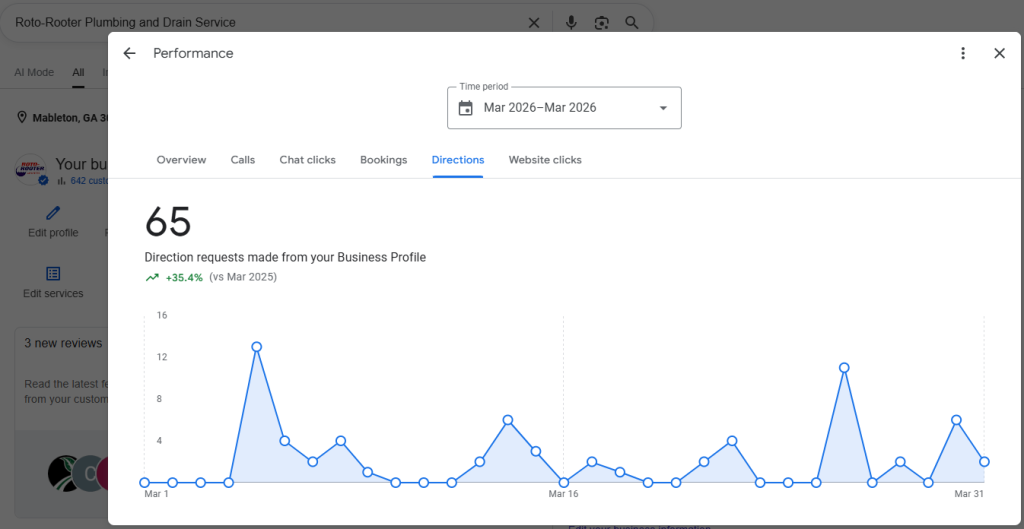
Roto-Rooter Plumbing and Drain Service in Lafayette, Louisiana increased direct calls from their Google Business Profile by 16.3% year-over-year, direction requests by 35.4%, and total profile interactions by 24.1% — all within a 5-month engagement window. More significantly, their Map Pack Top 3 coverage across the Lafayette grid nearly doubled in 60 days, from 19.8% to 34.6% of tracked grid points.
This case study documents exactly what was done, what the data showed, and what it means for plumbing companies and home service businesses competing in markets where national brand recognition alone does not produce local rankings.
The Results at a Glance — March 2026
| Metric | March 2026 | Year-Over-Year Change |
|---|---|---|
| Total GBP Interactions | 144 | +24.1% |
| Direct Calls | 50 | +16.3% |
| Direction Requests | 65 | +35.4% |
| Website Clicks | 29 | +16.0% |
| Map Pack Market Share | 68% | +10.0 pts |
Every call in that table represents a homeowner in a moment of need who chose this listing over every competitor in the Map Pack.
The Client: Roto-Rooter Plumbing and Drain Service, Lafayette, LA
Roto-Rooter is a nationally recognized franchise brand. The Lafayette location serves the city proper plus Youngsville, Broussard, Carencro, Scott, and surrounding communities across a metro radius of roughly 10 miles.
The national brand creates a trust advantage — but only once a customer sees the listing. It does nothing to guarantee the listing appears first. Map Pack ranking in Lafayette is determined entirely by local signals: category accuracy, service coverage, photo activity, post cadence, review velocity, and geographic signal strength. National brand equity is not a local ranking factor.
Map Ranking began working with this location in late 2025, implementing the Map Sense Plan — a structured optimization program covering Local SEO and GBP Optimization, Google Ads, Map Check-ins, CTR Booster, and Rank Tracker — aligned with our 90-day GBP framework: foundation optimization, geographic signal expansion, and systematic grid tracking across the Lafayette metro.
The Challenge: Strong Near the Address, Thin Across the Territory
At the start of the engagement, the GBP listing had solid baseline visibility near the business address. The problem was geographic: coverage thinned out significantly across the full service territory. Five specific gaps defined the starting position:
Average rank of 5.7 across the 9×9 grid. Ranking outside the Top 3 for the majority of tracked grid points means most of the service area sees competitors first, not Roto-Rooter.
Market share at 58.0%. The listing appeared in the Top 3 for fewer than 6 in 10 tracked positions — leaving more than 4 in 10 searches across the service area uncontested.
Map Pack Top 3 coverage at only 19.8% of grid points. Coverage was strong near the registered address but thin across Moncus, northern Lafayette, and Broussard — areas where technicians were actively working every week.
Direction requests lagging behind call volume. This signaled that the listing was capturing some calls but hadn’t yet built the level of Map Pack dominance where customers commit to navigating before they’ve even dialed.
Geographic coverage gaps in outer suburban zones. Technicians were serving these areas regularly. The GBP ranking signals hadn’t extended there yet.
The result was a profile that existed — with solid baseline authority — but wasn’t competing at the level the Lafayette plumbing market required.
The Map Ranking Approach: Six Optimization Pillars
The optimization program for Roto-Rooter Lafayette focused on the three core factors Google uses to rank local businesses — relevance, prominence, and geographic signal strength — executed across six specific workstreams.
1. Category and Relevance Optimization
Category selection is the most foundational local ranking signal in Google’s algorithm. The primary and secondary GBP categories were audited against actual search demand data and competitor category structures — ensuring Google fully understood the business’s complete service scope beyond the primary “Plumber” category.
Google cannot rank a business for queries it doesn’t associate with that business. Categories are the first and most direct relevance signal available in the GBP ecosystem.
2. Services and Attributes Buildout
The services section was rebuilt with keyword-aligned service names and descriptions, creating structured relevance signals for every high-value search term the Lafayette market generates: drain cleaning, sewer line repair, emergency plumbing, water heater installation, and hydro-jetting.
A complete services section expands the keyword footprint of the profile without requiring any changes to the website. It tells Google exactly what the business offers — in the language customers use when they search.
3. Photo Strategy
Job photos, truck photos, team photos, and equipment images were added with geo-tagged metadata. Photo freshness is an active relevance signal. A consistently updated photo set signals to Google’s local algorithm that the business is operating actively — not dormant. Each photo category sends a distinct relevance signal: work quality, geographic presence, team credibility.
4. GBP Post Cadence
Regular GBP posts were published on a structured schedule covering seasonal service angles, emergency availability messaging, and service-specific content. Consistent posting maintains the profile’s algorithmic freshness — a behavioral trust signal that compounds over time. An inactive profile signals low trust to both the algorithm and the customers who land on it.
5. Review Velocity and Response Strategy
New review acquisition was tracked against a 4-reviews-per-4-weeks milestone. Every incoming review received a keyword-rich, location-specific response — turning each review response into an additional relevance signal in full compliance with Google guidelines.
Review responses affect engagement signals independently from review volume. A profile with consistently responded reviews outperforms a profile with the same review count and no responses, all else equal.
6. Q&A Seeding
The Q&A section was populated with natural-language question-and-answer pairs aligned to high-intent plumbing searches. This tactic adds keyword-rich content directly to the profile page — without requiring any website changes — and addresses customer objections before a competitor gets the opportunity.
Map Pack Grid Results: Before and After (60 Days)
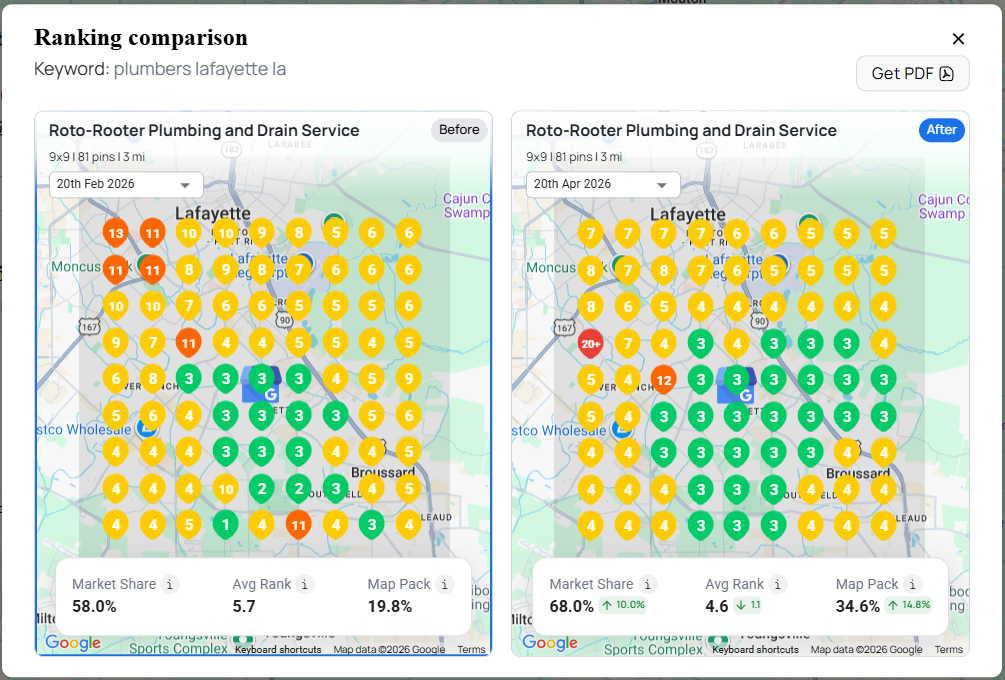
The GeoGrid comparison captures the Map Pack presence on February 20, 2026 (baseline) and April 20, 2026 — a 60-day window reflecting the Phase 2 optimization push across the Lafayette metro.
| Metric | Feb 20, 2026 | Apr 20, 2026 | Change |
|---|---|---|---|
| Average Rank (9×9 grid) | 5.7 | 4.6 | +1.1 positions improved |
| Market Share | 58.0% | 68.0% | +10.0 pts |
| Map Pack Top 3 Coverage | 19.8% of grid | 34.6% of grid | +14.8 pts |
Grid: 9×9 | 81 tracking points | 3-mile radius | Keyword: plumbers lafayette la
The Top 3 coverage gain is the most commercially significant number in this table. Going from 19.8% to 34.6% of grid points in the Map Pack Top 3 means that nearly twice as many locations across the Lafayette service area now show Roto-Rooter before any competitor — in 60 days.
The Full 5-Month Performance Picture
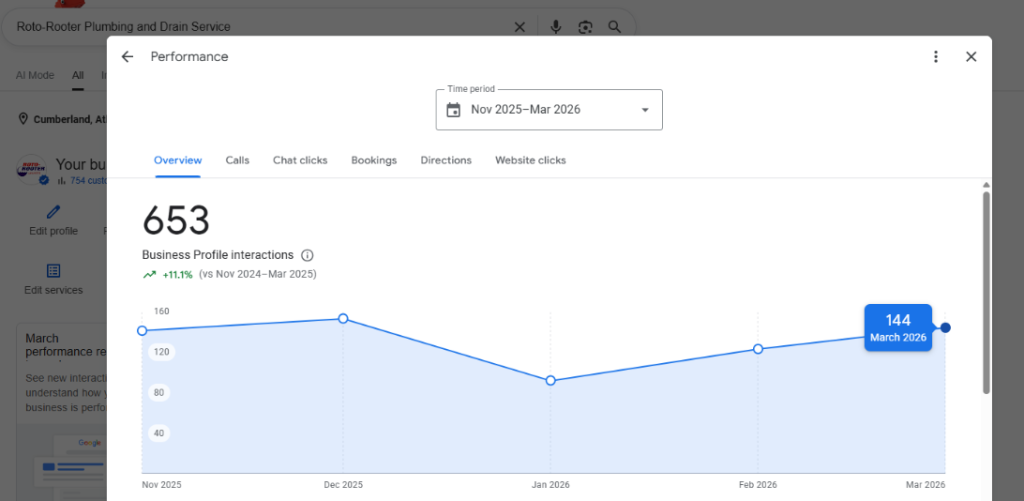
653 total GBP interactions over the 5-month engagement window (November 2025 through March 2026) — up 11.1% year-over-year, led by a 63.8% surge in direction requests.
| Month | Interactions | Calls | Directions | Website Clicks |
|---|---|---|---|---|
| Nov 2025 | ~160 | ~43 | ~100 | ~25 |
| Dec 2025 | ~155 | ~41 | ~108 | ~25 |
| Jan 2026 | ~100 | ~34 | ~28 | ~20 |
| Feb 2026 | ~94 | ~33 | ~56 | ~18 |
| Mar 2026 | 144 | 50 | 65 | 29 |
| 5-Mo Total | 653 (+11.1% YoY) | 321 (+63.8% YoY) |
The January dip reflects seasonal normalization typical for Louisiana plumbing services during mild winter months — not an optimization failure. The March recovery to 144 interactions and 50 calls, the strongest month of the engagement, confirms that compounding signal strength outpaces seasonal fluctuation when optimization is sustained.
Why Calls Are the Only Revenue Metric That Matters
50 direct calls from GBP in March 2026 alone. At a conservative 75% close rate and a $350 average service ticket, those 50 calls represent approximately $13,100 in potential monthly revenue directly attributable to the Google Business Profile. Larger jobs — sewer line replacements, water heater installs, hydro-jetting contracts — push individual ticket values to $1,500 to $5,000.
A 16.3% year-over-year increase in call volume is not a marketing vanity metric. It is a revenue line. Every percentage point of call growth in plumbing has a direct dollar equivalent, and those dollars compound month over month as optimization signals accumulate.
Why Direction Requests Are the Commitment Signal
65 direction requests in March 2026 represent customers who had already decided. They were navigating, not browsing. A direction request is the strongest behavioral intent signal a GBP listing produces — it means the Map Pack won the trust decision before the competitor even got a shot.
A 35.4% year-over-year increase in directions means a materially larger share of the Lafayette market is committing to Roto-Rooter at the moment of highest purchase intent. Across the full 5-month window, direction requests totaled 321 — up 63.8% year-over-year. That trajectory does not happen by accident.
Key Takeaways: What This Case Validates for Plumbing and Home Services
Map Pack rankings are not permanent — but they are buildable. The Lafayette data shows what consistent, structured optimization produces across a 60 to 90-day window. It is not a spike. It is a compounding curve.
Market share beats average rank. A strong rank near the registered address means nothing if 40% of the service territory is dark. Geographic coverage across the full grid drives total call volume — not proximity performance at a single point.
Direction requests signal commitment, not curiosity. When direction growth outpaces call growth, the Map Pack is consistently winning the trust decision before competitors get a chance to compete. That is the goal of local SEO — not just visibility, but decisive visibility.
Seasonal dips are normal and recoverable. January showed a natural dip. March came back as the strongest month of the engagement. Sustained optimization compounds regardless of seasonal patterns — businesses that pause optimization during slow months lose the compounding advantage they spent months building.
National brand recognition plus local GBP optimization equals compounding authority. Brand recognition creates a trust baseline once a customer sees the listing. Local SEO determines whether they see it first. The combination is more powerful than either factor alone.
The grid tells the real story. Average rank hides geographic holes. A 9×9 grid with 81 tracking points reveals exactly where calls are being won and exactly where competitors are capturing demand that should belong to this listing.
A Note for Franchise Operators and Multi-Location Brands
National brand recognition creates a trust advantage once a customer sees your listing. It does nothing to ensure they see it first. That gap — between brand awareness and local discoverability — is exactly where Map Ranking operates.
For franchise operators and multi-location service brands, this dynamic compounds across every market you serve. Each location has its own GBP, its own competitive landscape, and its own ranking signals that must be built and maintained independently. A strong performance at a flagship location tells you nothing about how your other markets are ranking.
At $13,000 or more in potential monthly call value for a single plumbing location, the cost of underperforming in even one market adds up fast across a franchise network. Map Ranking’s 90-day framework was designed to be deployable location by location, with consistent methodology and measurable grid-based tracking at every level.
The Roto-Rooter Lafayette case is not just a success story. It is a proof of concept for what structured local SEO expertise produces for every location in a network — starting with the ones leaving the most calls on the table.
Frequently Asked Questions About Local SEO for Plumbing Companies
How long does it take to see Map Pack ranking improvements for a plumbing business?
Most plumbing businesses see meaningful grid movement within 60 to 90 days of a structured optimization push. The Roto-Rooter Lafayette case documented a 14.8-point gain in Map Pack Top 3 coverage within a 60-day window. Full compounding effects — including call volume growth and sustained direction request increases — typically emerge between months three and five.
Does a national franchise brand automatically rank well in local Map Pack searches?
No. Map Pack ranking is determined by local signals: category accuracy, services section completeness, photo activity, post cadence, review velocity, and geographic signal strength. National brand equity is not a ranking factor in Google’s local algorithm. Each franchise location requires its own independent optimization program.
What does Map Pack market share actually measure?
Market share in a GBP rank tracker reflects the percentage of tracked grid points where the listing appears in the Map Pack Top 3. A market share of 58% means the listing is in the Top 3 for fewer than 6 in 10 positions across the service area grid. Increasing market share directly correlates with increased call volume because more customers see the listing first at more geographic points across the territory.
Why do direction requests matter for a plumbing business?
Direction requests are the highest-intent behavioral signal a GBP listing produces. A customer requesting directions has already decided — they are navigating to the business or have committed to the service provider. Direction request volume is a leading indicator of Map Pack dominance: when a listing consistently wins direction requests, it is winning the trust decision before competitors get a chance to compete.
What is a GeoGrid rank tracker and why does it matter more than average rank?
A GeoGrid rank tracker plots a business’s Map Pack position across a grid of geographic points — in this case, 81 points across a 9×9 grid covering a 3-mile radius. Average rank is a single aggregated number that hides geographic performance gaps. The grid reveals exactly which parts of the service territory are ranking in the Top 3 and which are dark — where competitors are capturing demand that should belong to this listing.
About Map Ranking
Map Ranking is a local SEO agency specializing in Google Business Profile optimization and Map Pack rankings for home service businesses across the United States. Our Map Sense Plan combines GBP optimization, Map Check-ins, CTR Booster, and Rank Tracker into a structured 90-day framework designed to expand Map Pack coverage across the full service territory — not just near the business address.
Learn more at MapRanking.com or book a call to find out how your plumbing or home service business can compete for the calls your competitors are currently taking.

