
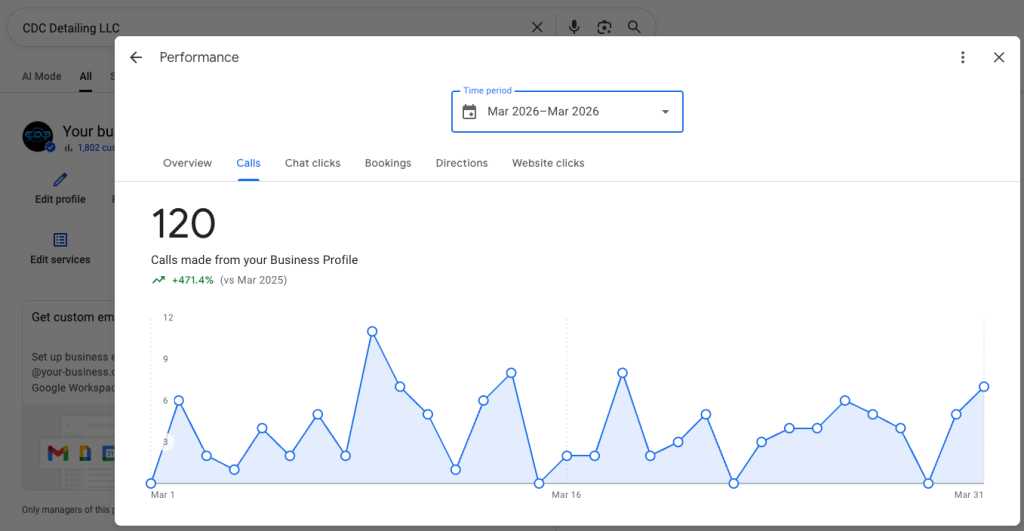
CDC Detailing LLC, an auto detailing business in Pitman, New Jersey, increased calls from their Google Business Profile by 471% in five months — from 21 calls per month to 120 — through a structured GBP optimization strategy that combined profile completeness, geotagged check-ins, and consistent posting cadence.
This case study documents exactly what was done, what the data showed, and what service-area businesses can replicate to dominate their local Map Pack.
What Is Google Business Profile Optimization for Service-Area Businesses?
Google Business Profile (GBP) optimization for service-area businesses is the process of improving a Google listing to rank in the local Map Pack — the top three business results that appear in Google Search and Google Maps. For businesses that serve customers at their location or travel to customer locations, GBP is often the single most important source of phone calls and leads.
A fully optimized GBP includes:
- Accurate primary and secondary business categories
- Complete services section with descriptions and pricing signals
- High-volume, high-variety photo library
- Consistent weekly posting cadence
- Active review generation and response strategy
- Geotagged activity signals from real job locations
The Client: CDC Detailing LLC
Business type: Auto detailing (shop + mobile service) Location: Pitman, New Jersey Service area: Greater Philadelphia and South Jersey corridor Engagement start: November 2025 Results measured: March 2026 vs. March 2025
CDC Detailing had an existing Google Business Profile before working with Map Ranking. The profile existed — but it wasn’t competitive. Categories were not fully optimized, the services section was sparse, photos lacked variety, and there was no posting cadence or review response strategy.
The Problem: Why Most Local Business Profiles Underperform
Before the Map Ranking engagement, CDC Detailing’s GBP had six specific gaps:
1. Incomplete category structure. The primary and secondary categories were not aligned with high-value search queries that customers actually use.
2. Sparse services section. Google uses the services section to understand what a business offers. Without detailed service descriptions, CDC Detailing was invisible for many relevant searches.
3. Low photo volume and variety. Google rewards profiles with consistent photo activity. Profiles with more photos across more categories (exterior, interior, team, before/after) generate higher engagement.
4. No posting cadence. An inactive profile signals low trust to both the algorithm and potential customers. Without weekly posts, the profile appeared dormant.
5. No review response strategy. Responding to reviews is a behavioral engagement signal. Ignoring reviews leaves a ranking input untapped.
6. Generic business description. The profile description was not written to match local search intent or include relevant keywords.
The result: CDC Detailing appeared in search results occasionally, but rarely in the top three Map Pack positions that drive 70-80% of clicks and calls.
The GBP Optimization Strategy (Step by Step)
Map Ranking implemented a six-part GBP optimization program based on the three core factors Google uses to rank local businesses: relevance, prominence, and behavioral signals.
Step 1: Category and Relevance Optimization
Category selection is the most foundational local ranking signal. The primary and secondary categories were audited against competitor data and actual search volume — then updated to match what high-ranking profiles in the auto detailing niche were using.
Why this matters: Google cannot rank a business for queries it doesn’t associate with that business. Categories are the primary signal Google uses to determine relevance.
Step 2: Services and Attributes Buildout
The services section was rebuilt from scratch with:
- Individual service listings for each detailing type (interior, exterior, ceramic coating, etc.)
- Detailed service descriptions for each offering
- Pricing signals where appropriate
- Structured attributes that communicate capacity, service type, and customer fit
Why this matters: A complete services section expands the keyword footprint of the profile without requiring any additional content on the website.
Step 3: Photo Strategy
A systematic photo upload plan was implemented covering:
- Exterior shop photos
- Interior and detail work in progress
- Before-and-after results
- Team photos
Photo volume and variety both matter. Each photo category sends a different relevance signal to Google.
Step 4: GBP Post Cadence
Weekly posts were published using three post types: service highlights, promotional offers, and educational content. Consistent posting signals to Google that the profile is actively managed — a behavioral trust signal that compounds over time.
How often to post: At minimum, once per week. Businesses in competitive markets often benefit from 2-3 posts per week.
Step 5: Review Velocity and Response Strategy
A review generation system was implemented to increase the volume of incoming reviews. Every review received a response within 24-48 hours using a structured response protocol that:
- Acknowledged the customer by name
- Referenced the specific service
- Included relevant keywords naturally
- Encouraged return visits
Why responses matter: Review responses are a behavioral engagement signal that improves both prominence rankings and the conversion rate of profile visitors into callers.
Step 6: Q&A Seeding
Frequently asked questions were added proactively to the GBP’s Q&A section. This tactic adds keyword-rich content directly to the profile page and improves the searcher experience — without requiring any website changes.
The Featured Tactic: Map Check-Ins as a Geographic Ranking Signal
Of all the tactics in the engagement, Map Check-Ins produced the most distinctive result — and addresses a problem that most service-area businesses never solve.
The Problem with Service-Area Proximity Bias
Google’s local ranking algorithm defaults to proximity from the business’s registered address. For a shop-based business like CDC Detailing, this means strong rankings near Pitman, NJ — and weak visibility in Cherry Hill, Voorhees, or Philadelphia suburbs, even when the team drives there every week.
Without additional signals, a mobile detailer is nearly invisible in most of their actual service territory.
What Map Check-Ins Does
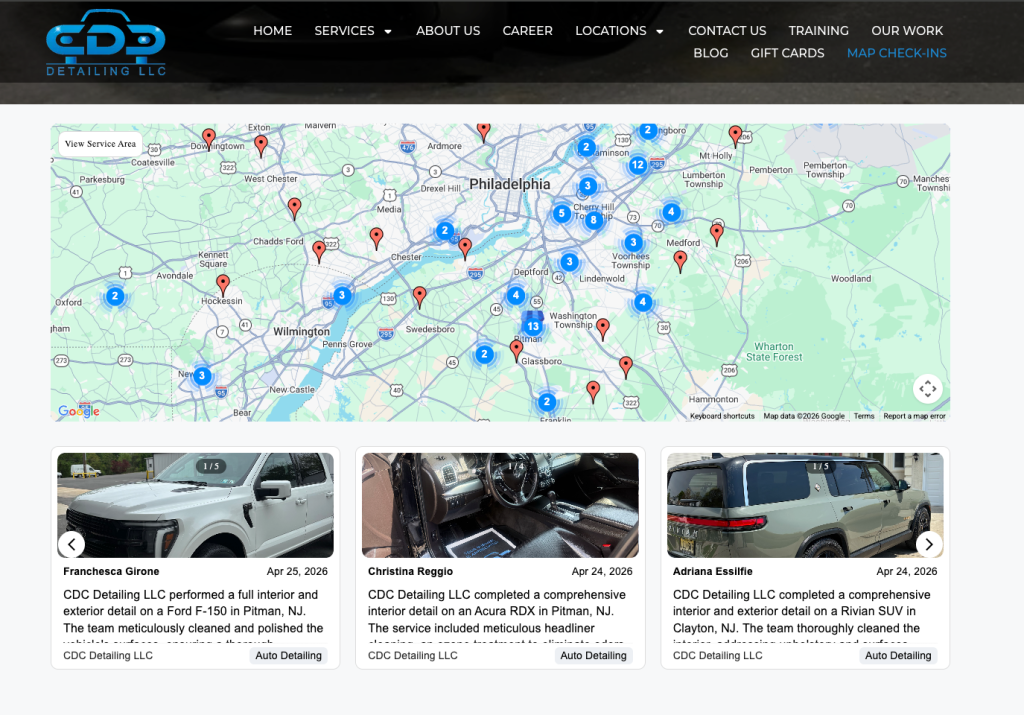
Map Check-Ins is a tool that allows field teams to check in from real job locations. Each check-in automatically publishes a geotagged post — with a real photo from the real job site — to:
- Google Business Profile
- The company website
The result is a continuous stream of location-specific activity signals that tell Google: this business is active here, serves this area, and has the documented presence to back it up.
CDC Detailing’s Check-In Results
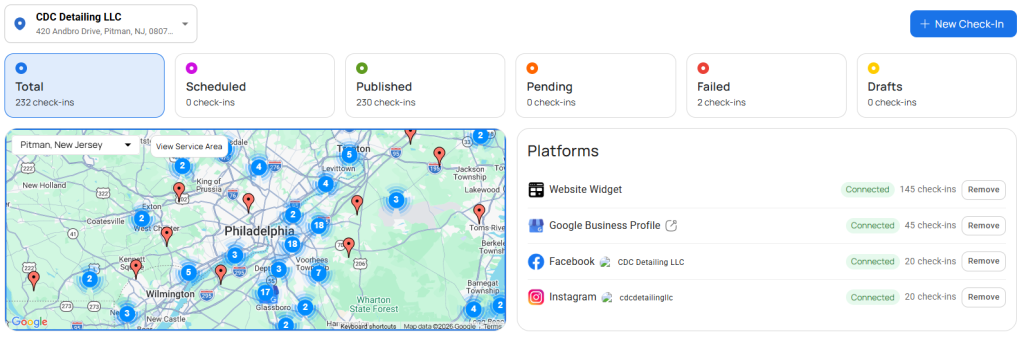
Over the five-month engagement, CDC Detailing logged:
| Platform | Check-Ins Published |
|---|---|
| Total check-ins | 232 |
| Published live | 230 |
| On company website | 145 |
| On Google Business Profile | 45 |
| On Facebook | 20 |
| On Instagram | 20 |
The 230 published check-ins were distributed across a wide geographic corridor — from Philadelphia and its suburbs through Camden County, Burlington County, and down through South Jersey into Pitman/Glassboro.
Why This Expands Map Pack Visibility
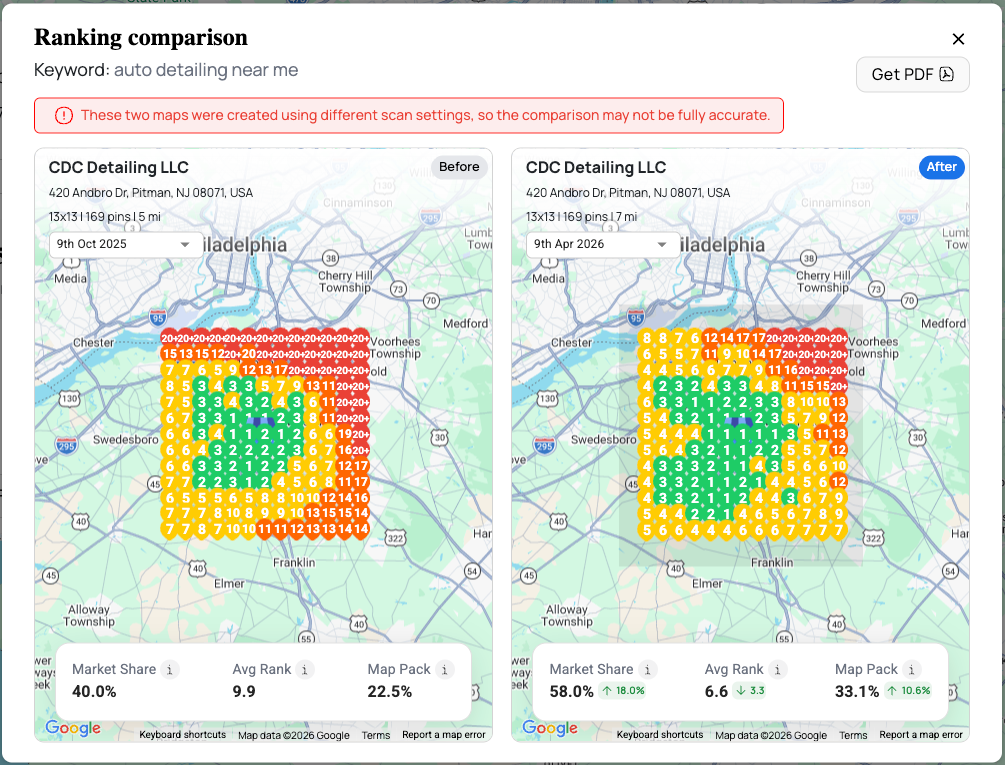
Each check-in from a real job location sends Google a documented signal that the business actively works in that area. Over time, this expands the geographic footprint of the business in Google’s local ranking model — meaning CDC Detailing began ranking in Map Pack positions in neighborhoods where it previously had no visibility.
The commercial logic: The shop wins walk-in customers near Pitman. The check-ins win customers across the entire 30-40 minute service radius. Both revenue streams require different ranking signals.
Results: 5 Months of GBP Optimization Data
Primary Metrics (March 2026 vs. March 2025)
| Metric | March 2026 | Year-Over-Year Change |
|---|---|---|
| GBP Calls | 120 | +471.4% |
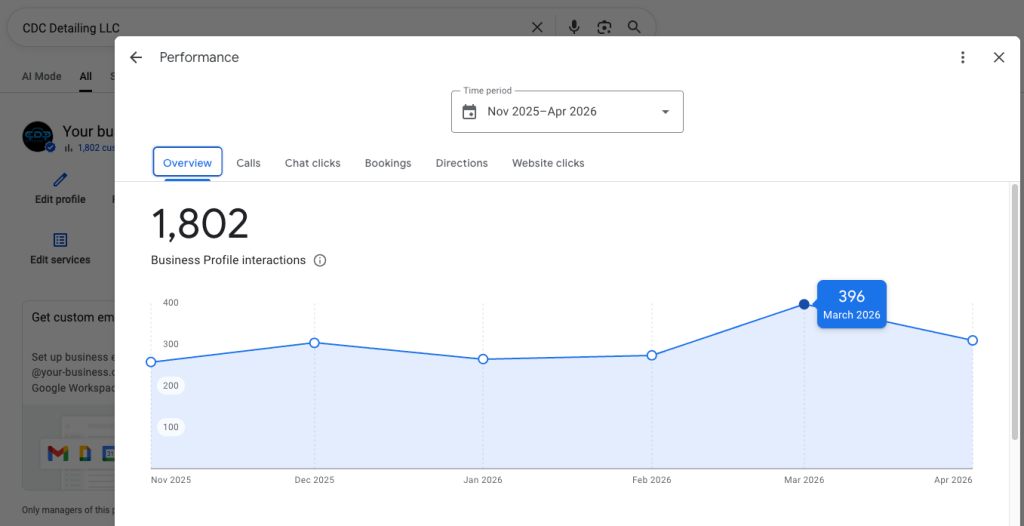
| Profile Interactions | 396 | +67.8% |
| Profile Views | 1,418 | +13.4% |
| Website Clicks | 194 | +35.7% |
| Direction Requests | 77 | +6.9% |
Monthly Profile Interaction Trend (November 2025 – March 2026)
| Month | Profile Interactions |
|---|---|
| November 2025 | 237 |
| December 2025 | 302 |
| January 2026 | 266 |
| February 2026 | 292 |
| March 2026 | 396 (peak) |
Total interactions over 5 months: 1,493 — a +68.1% increase compared to the same period the prior year.
The growth pattern is significant: this was not a spike. It was a consistent upward trend across five consecutive months, which is the hallmark of accumulated optimization signals — not a short-term anomaly.
Why Call Volume Is the Most Important Metric
Of all GBP metrics, calls are the most commercially significant. A caller from GBP is someone who:
- Searched for auto detailing
- Saw the Map Pack listing
- Chose CDC Detailing over competitors
- Picked up the phone
Going from 21 to 120 calls per month represents roughly 99 additional high-intent contacts per month — customers who self-selected the business at the moment of peak purchase intent.
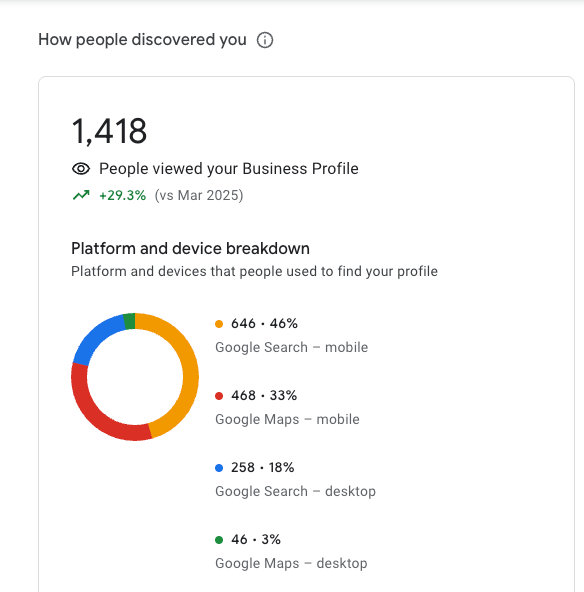
How Customers Are Finding the Profile
Platform and device breakdown for March 2026:
| Discovery Source | Profile Views | Share |
|---|---|---|
| Google Search — Mobile | 646 | 46% |
| Google Maps — Mobile | 468 | 33% |
| Google Search — Desktop | 258 | 18% |
| Google Maps — Desktop | 46 | 3% |
Key insight: 79% of all profile views came from mobile devices. For service-area businesses, GBP optimization must prioritize the mobile Map Pack experience. Desktop optimization is secondary.
Key Takeaways: What Local SEO Principles This Case Validates
The CDC Detailing LLC results confirm several principles that apply across service-area businesses in any niche:
GBP is not a static asset. Active management — posting, responding to reviews, uploading photos, and generating field check-ins — compounds over time. Businesses that treat their profile as a set-it-and-forget-it listing consistently underperform against actively managed profiles.
Call volume is a revenue signal, not a vanity metric. Optimizing GBP for call volume is optimizing for revenue. Every additional call represents a real business opportunity.
Mobile dominates local search. Nearly 80% of local profile views come from mobile devices. Any optimization strategy that prioritizes desktop experience is misaligned with where local intent actually lives.
Category accuracy is foundational. Google cannot rank a business for searches it doesn’t understand. Category and services accuracy is the prerequisite for everything else.
Behavioral signals are both inputs and outputs. Calls, clicks, and direction requests are outcomes of good optimization — and they are also inputs that tell Google the profile is performing well. A profile that performs well gets rewarded with more visibility, which drives more behavioral signals. The cycle compounds.
Geographic signals from the field are as important as profile signals. A service-area business that checks in from real job sites builds ranking authority across its full territory — not just within proximity of its registered address.
Results accumulate. The five-month trajectory from 237 to 396 monthly interactions reflects optimization signals building on each other — not a single tactic working in isolation.
Frequently Asked Questions
How long does GBP optimization take to show results?
Most businesses see meaningful improvement in 60-90 days. Full compounding effects from consistent posting, check-ins, and review velocity typically emerge between months three and five. CDC Detailing saw its peak month in month five.
Do Map Check-Ins directly cause higher rankings?
Map Check-Ins send geotagged location signals to Google through GBP posts published from real job locations. These signals expand the geographic footprint of the business in Google’s understanding of where it operates. The correlation between consistent check-in activity and expanded Map Pack visibility is documented across multiple service-area business engagements.
What types of businesses benefit most from GBP optimization?
Service-area businesses with mobile teams — auto detailing, HVAC, roofing, plumbing, landscaping, pest control, cleaning services — benefit most from geotagged check-in strategies because their revenue territory is larger than their proximity radius. Brick-and-mortar businesses with fixed locations benefit most from profile completeness, review velocity, and posting cadence.
How many GBP posts per week are needed?
One post per week is the minimum for maintaining active profile status. Businesses in competitive markets typically see better results with two to three posts per week. Post types should vary across service highlights, offers, and educational content.
What is the relationship between reviews and local rankings?
Reviews influence local rankings through two mechanisms: review velocity (the rate at which new reviews are generated) affects prominence signals, and review responses affect engagement signals. Both are separate inputs. A profile with 50 responded reviews will typically outrank a profile with 50 unresponded reviews, all else equal.
What percentage of local searches come from mobile?
Across service-area business profiles analyzed by Map Ranking, mobile accounts for 75-80% of GBP profile views. Google Search mobile is consistently the largest single source of discovery, followed by Google Maps mobile.
About Map Ranking
Map Ranking is a local SEO agency specializing in Google Business Profile optimization and Map Pack rankings for service-area businesses across the United States. The Map Check-Ins platform is one of the tools available through Map Ranking for businesses that serve customers in the field.
Learn more at MapRanking.com or visit MapRanking.com/map-check-ins to see how geotagged check-ins work for your service area.

