We ran an experiment across ChatGPT, Gemini, Perplexity, and Google’s AI Mode to see how AI assistants actually decide which local businesses to recommend. The results are a little surprising, and if you’re already doing the fundamentals, they’re very good news.
The new front door to your business
Picture two roofing companies on the same street in Los Angeles.
The first owner has spent years quietly doing great work. Solid reviews. A tidy website. A Google listing he set up once and hasn’t touched since.
The second owner does the same quality of work but her business shows up everywhere online. On Yelp. On the BBB. In the “best roofers in LA” articles. On Google Maps. And her website says, in plain English, exactly what she does and where she does it.
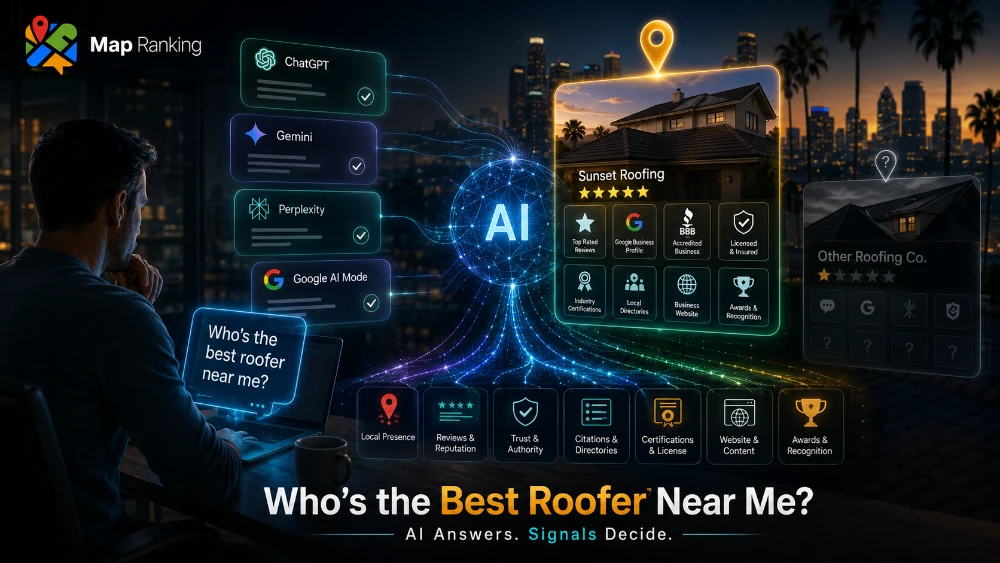
Now a homeowner two miles away has a leak. A year ago, that homeowner would have opened Google and scrolled. Today, more and more of them open ChatGPT or Gemini, or Google’s new AI Mode and simply ask: “Who’s the best roofer near me?”
The AI answers in a sentence or two. It names two or three companies.
Here’s the uncomfortable question for every local business owner: when that happens, is your name in the answer or your competitor’s?
We wanted to know how the AI actually decides. So we tested it.
What we did (and why you can trust it)
We picked one trade (roofing) in one city (Los Angeles) and asked four AI assistants the same three questions a real homeowner would ask:
- “What are the best roofing companies in Los Angeles?”
- “Which roofing companies specialize in roof replacement?”
- “Which have the best reviews and reputation?”
Then we did the tedious part. For every single answer, we recorded which businesses got named, and we opened every source the AI displayed to see where it was actually pulling its information from: reviews, directories, articles, or the businesses’ own websites.
We didn’t guess. We read the receipts.
Four surprises
1. Every AI plays a different game. There is no single “AI search.” Google’s AI Mode was a firehose. It leaned on dozens of sources per answer, especially Google’s own business listings, review sites, and directories. Perplexity leaned hard on directories like Yelp, the BBB, and industry-specific ones. ChatGPT was picky and short, often citing “best of” articles and the moment we asked about a specific service, it jumped straight to companies’ own websites.
2. One AI didn’t show its work at all. Gemini named businesses confidently but showed zero sources. And it picked differently from everyone else. It favored companies that had been around for decades, held the right licenses, carried manufacturer certifications, and had won awards, it wasn’t counting reviews. It was rewarding reputation and credentials.
3. No business won everywhere. Not a single roofer showed up across all four assistants. The companies that dominated on ChatGPT, Perplexity, and AI Mode were almost completely absent from Gemini and vice versa. Getting recommended by AI isn’t one victory. It’s several.
4. AI “shows its work,” but the work is often loose. When we checked the sources the AIs displayed, only about half actually backed up the specific business being recommended. One answer to a question about Los Angeles even pulled in a roofing company that operates in Mississippi and Louisiana not California at all. AI sounds certain. It isn’t always right.
The insight that changes everything
Here’s what jumped out once we stepped back:
AI isn’t inventing these recommendations out of thin air. It’s reading the exact same signals that decide who wins on Google Maps, the signals a good local SEO program has been building for years.
Look at what the AIs actually pulled from:
- Your Google Business Profile: Google’s AI Mode pulled its own business listings directly into the answer.
- Review sites and directories: Yelp, the BBB, Yellow Pages. These were the connective tissue across three of the four platforms.
- Industry-specific directories and certifications: like manufacturer “certified contractor” listings.
- A steady stream of strong reviews: “5.0 stars, 119 reviews” was the kind of phrase the AIs kept repeating back.
- Your own website: especially clear service pages that state exactly what you do.
- Your reputation and credentials across the web: how long you’ve been in business, your license, your awards.
If that list looks familiar, it should. It’s the local SEO fundamentals.
The good news for your business
When your customers ask AI for a recommendation, the names that come up belong to the businesses that:
- Show up consistently across Google, Yelp, the BBB, and industry directories with the same name, address, and phone number everywhere.
- Keep a healthy, fresh stream of reviews coming in.
- Have a website that clearly states their services and their service area.
- Have real credentials and a real track record that’s actually visible online.
This is exactly what our Map Pack Dominator program is built to do. Every one of those signals is already part of the work: optimizing your Google Business Profile, building and cleaning up your directory listings, driving a steady flow of reviews, and structuring your website so both people and machines understand what you offer and where.
In other words if you’re already running the fundamentals, you are not starting from zero in the AI era. You’re already positioned to be the name the AI mentions. That’s the whole point: the work that gets you into Google’s Map Pack is the same work that gets you into the AI’s answer.
The one thing most businesses miss
Remember Gemini, the assistant that ignored reviews and rewarded credentials instead? That’s the part most businesses overlook.
To win the “reputation and authority” game, collecting reviews isn’t enough. You also need the web to consistently reflect who you are: how long you’ve been around, the licenses you hold, the manufacturer certifications you carry, the awards you’ve earned repeated everywhere your business appears, not buried on a single page.
This is the layer we lean into hardest for clients who want to be everywhere, not just on the map. And it’s no coincidence that it’s the same thing that earns trust with human customers.
What this study does not prove
We believe in being straight with you. This was one trade, in one city, at one moment in time. AI tools change their behavior constantly, and the sources they show may not be every source they use. This experiment reveals clear, consistent patterns in how AI surfaces local businesses, it does not hand anyone a secret formula. If someone promises you guaranteed AI rankings, they’re selling something we wouldn’t.
What we can say with confidence: the businesses AI recommends look a lot like the businesses that already win locally and the roadmap to become one of them is the one we drive every single day.
So, will your name come up?
If your customers asked ChatGPT, Gemini, or Google’s AI who the best business in your industry is, right now, in your city, would you be in the answer?
We’ll find out for you.

